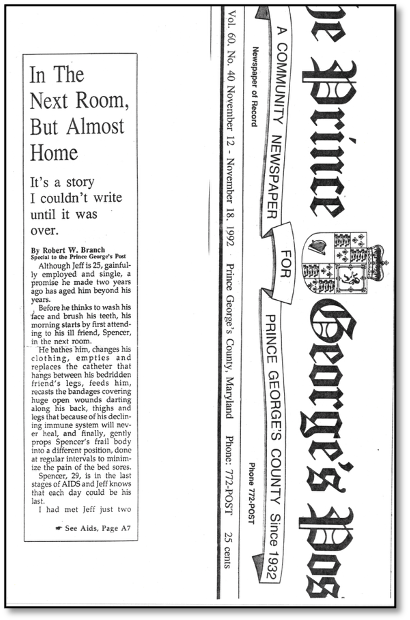
In 1992, when I was 26, I worked as a freelance reporter for an African American man named Legusta Floyd, Sr. at The Prince George’s Post, a community newspaper that was founded in Prince George’s County, Maryland in 1932. From age three, I was raised in that county. In the November 12-18, 1992 edition of the weekly newspaper, which at the time cost 25 cents, I published this article.
In the Next Room, But Almost Home. It’s a story I couldn’t write until it was over.
By Robert Wesley Branch | November, 1992 | Special to The Prince George’s Post
Although Jeff is 25, gainfully employed and single, a promise he made two years ago has aged him beyond years.
Before he thinks to wash his face and brush his teeth, his morning starts by first attending to his ill friend, Spencer, in the next room.
He bathes him, changes his clothing, empties and replaces the catheter that hangs between his bedridden friend’s legs, feeds him, recasts the bandages covering huge open wounds darting along his back, thighs and legs that because of his declining immune system will never heal, and finally, gently prop Spencer’s frail body into a different position, done at regularly intervals to minimize the pain of the bed sores.
Spencer, 29, is in the last stages of AIDS and Jeff knows that each day could be his last.
I had met Jeff just two weeks before that day I went to his home in Northwest Washington, D.C. to learn more about his friend, Spencer.
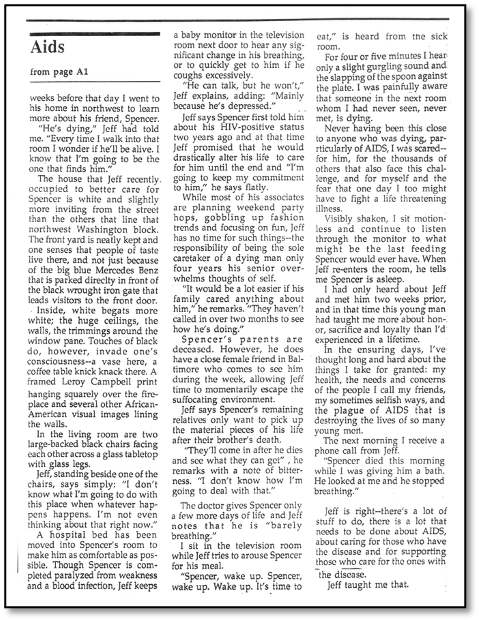
“He’s dying,” Jeff told me. “Every time I walk into that room I wonder if he’ll be alive. I know that I’m going to be the one that finds him.”
The house that Jeff recently occupied to better care for Spencer is white and slightly more inviting from the street than the others that line that Northwest Washington block. The front yard is neatly kept and one senses that people of taste live there, and not just because of the big blue Mercedes Benz that is parked directly in front of the black wrought iron gate that leads visitors to the front door.
Inside, white begats more white; the huge ceilings, the walls, the trimmings around the windowpane. Touches of black do, however, invade one’s consciousness – a vase here, a coffee table knick-knack there. A framed Leroy Campbell print hanging squarely over the fireplace and several other African American visual images lining the walls.
In the living room are two large-backed black chairs facing each other across a glass tabletop with glass legs.
Jeff, standing beside one of the chairs, says simply: “I don’t know what I’m going to do with this place when whatever happens happens. I’m not even thinking about that right now.”
A hospital bed has been moved into Spencer’s room to make him as comfortable as possible. Though Spencer is completely paralyzed from weakness and a blood infection, Jeff keeps a baby monitor in the television room next door to hear any significant changes in his breathing, or to quickly get to him if he coughs excessively.
“He can talk, but he won’t,” Jeff explains, adding: “Mainly because he’s depressed.”
Jeff says Spencer first told him about his HIV-positive status two years and at that time Jeff promised that he would drastically alter his life to care for him until the end and “I’m going to keep my commitment to him,” he says flatly.
While most of his associates are planning weekend party hops, gobbling up fashion trends and focusing on fun, Jeff has no time for such things – the responsibility of being the sole caretake of a dying man only four years his senior overwhelms thoughts of self.
“It would be a lot easier if his family cared anything about him,” he remarks. “They haven’t called in over two months to see how he’s doing.”
Spencer’s parents are deceased. However, he does have a close female friend in Baltimore who comes to see him during the week, allowing Jeff time to momentarily escape the suffocating environment.
Jeff says Spencer’s remaining relatives only want to pick up the material pieces of his life after their brother’s death.
“They’ll come in after he dies and see what they can get,” he remarks, with a note of bitterness. “I don’t know how I’m going to deal with that.”
The doctor gives Spener only a few more days of life and Jeff notes that he is “barely breathing.”
I sit in the television room while Jeff tries to arouse Spencer for his meal.
“Spencer, wake up, Spencer, wake up. Wake up. It’s time to seat,” is heard from the sick room.
For four or five minutes I hear only a slight gurgling sound and the slapping of the spoon against the plate. I was painfully aware that someone in the next room whom I had never seen, never met, is dying.
Never having been this close to anyone who was dying, particularly of AIDS, I was scared – for him, for the thousands of others that also face this challenge, and for myself and the fear that one day I too might have to fight a life-threatening illness.
Visibly shaken, I sit motionless and continue to listen through the monitor to what might be the last feeding Spencer would ever have. When Jeff re-enters the room, he tells me Spencer is asleep.
I had only heard about Jeff and met him two weeks prior, and in that time this young man had taught me more about honor, sacrifice and loyalty than I’d experienced in a lifetime.
In the ensuing days, I’ve thought long and hard about the things I take for granted: my health, the needs and concerns of the people I call my friends, my sometimes selfish ways, and the plague of AIDS that is destroying the lives of so many young men.
The next morning I receive a phone call from Jeff.
“Spencer died this morning while I was giving him a bath. He looked at me and he stopped breathing.”
Jeff is right – there’s a lot of stuff to do, there is a lot that needs to be done about AIDS, about caring for those who have the disease and for supporting those who care for the ones with the disease.
Jeff taught me that.